and explain the factors that affect basal metabolic rate.
Summarize why the amount of food we eat (appetite) is not completely under our conscious control.
Energy
Intake Balances
Energy
Output To Maintain Weight
Recall that the
macronutrients
you consume are either converted to
energy
, stored, or used to synthesize macromolecules. A nutrient’s metabolic path is dependent upon
energy balance
. When you are in a positive
energy balance
the excess nutrient
energy
will be stored or used to grow (e.g., during childhood, pregnancy, and wound healing). When you are in negative
energy balance
you aren’t taking in enough
energy
to meet your needs, so your body will need to use its stores to provide
energy
.
Energy balance
is achieved when intake of
energy
is equal to
energy
expended. Weight can be thought of as a whole body estimate of
energy balance
; body weight is maintained when the body is in
energy balance
, lost when it is in negative
energy balance
, and gained when it is in positive
energy balance
. In general, weight is a good predictor of
energy balance
, but many other factors play a role in
energy
intake and
energy
expenditure. Some of these factors are under your control and others are not. Let us begin with the basics on how to estimate
energy
intake,
energy
requirement, and
energy
output. Then we will consider the other factors that play a role in maintaining
energy balance
and hence, body weight.
Estimating
Energy
Requirement
To maintain body weight you have to balance the calories obtained from food and beverages with the calories expended every day. Here, we will discuss how to calculate your
energy
needs in kilocalories per day so that you can determine whether your caloric intake falls short, meets, or exceeds your
energy
needs. The Institute of Medicine has devised a formula for calculating your
Estimated Energy Requirement (EER)
. It takes into account your age, sex, weight, height, and physical activity level (PA). The EER is a standardized mathematical prediction of a person’s daily
energy
needs in kilocalories per day required to maintain weight. It is calculated via the following formulas:
The numbers within the equations for the EER were derived from measurements taken from a group of people of the same sex and age with similar body size and physical activity level. These standardized formulas are then applied to individuals whose measurements have not been taken, but who have similar characteristics in order to estimate their
energy
requirements. Thus, a person’s EER is, as the name suggests, an estimate for an average person of similar characteristics. EER values are different for children, pregnant or lactating women, and for overweight and
obese
people. Also, remember the EER is calculated based on weight maintenance, not for weight loss or weight gain.
The 2010 Dietary Guidelines provides a table (Table 11.3.2) that gives the estimated daily
calorie
needs for different age groups of males and females with various activity levels. The 2010 Dietary Guidelines also states that while knowing the number of calories you need each day is useful, it is also pertinent to obtain your calories from
nutrient-dense foods
and consume the various
macronutrients
in their Acceptable Macronutrient Distribution Ranges (AMDRs) (Table 11.3.3).
Table 11.3.3: Acceptable Macronutrient Distribution Ranges
Age
Carbohydrates
(% of Calories)
Protein (% of Calories)
Fat (% of Calories)
Young Children (1–3)
45–65
5–20
30–40
Older children/adolescents (4–18)
45–65
10–30
25–35
Adults (19 and older)
45–65
10–35
20–35
Source: Institute of Medicine. “Dietary Reference Intakes:
Macronutrients
.” Dietary Reference Intakes for
Energy
, Carbohydrate. Fiber, Fat,
Fatty Acids
, Cholesterol, Protein, and
Amino Acids
. September 5, 2002. www.iom.edu/~/media/Files/Act...onutrients.pdf
Total
Energy
Expenditure (Output)
The amount of
energy
you expend every day includes not only the calories you burn during physical activity, but also the calories you burn while at rest (
basal metabolism
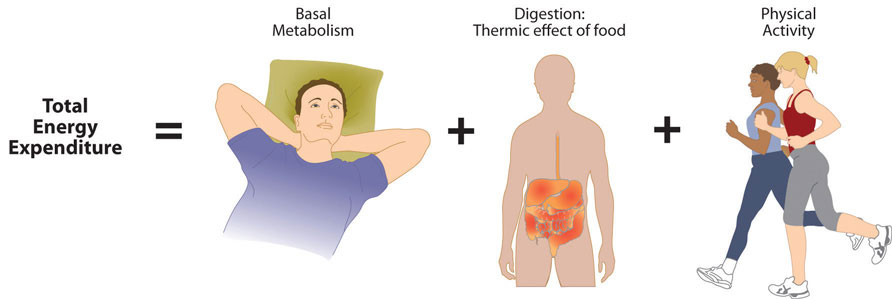
), and the calories you burn when you digest food. The sum of caloric expenditure is referred to as total
energy
expenditure (TEE).
Basal metabolism
refers to those metabolic pathways necessary to support and maintain the body’s basic functions (e.g. breathing, heartbeat, liver and kidney function) while at rest. The basal metabolic rate (BMR) is the amount of
energy
required by the body to conduct its basic functions over a certain time period. The great majority of
energy
expended (between 50 and 70 percent) daily is from conducting life’s basic processes. Of all the
organs
, the liver requires the most
energy
(Table 11.3.4). Unfortunately, you cannot tell your liver to ramp up its activity level to expend more
energy
so you can lose weight. BMR is dependent on body size, body composition, sex, age, nutritional status, and genetics. People with a larger frame size have a higher BMR simply because they have more mass. Muscle tissue burns more calories than fat tissue even while at rest and thus the more muscle mass a person has, the higher their BMR. Since females typically have less muscle mass and a smaller frame size than men, their BMRs are generally lower than men’s. As we get older muscle mass declines and thus so does BMR. Nutritional status also affects
basal metabolism
. Caloric restriction, as occurs while dieting, for example, causes a decline in BMR. This is because the body attempts to maintain homeostasis and will adapt by slowing down its basic functions to offset the decrease in
energy
intake. Body temperature and thyroid hormone levels are additional determinants of BMR.
Table 11.3.4:
Energy
Breakdown of
Organs
Organ
Percent of
Energy
Expended
Liver
27
Brain
19
Heart
7
Kidneys
10
Skeletal muscle (at rest)
18
Other
organs
19
The
energy
required for all the enzymatic reactions that take place during food digestion and absorption of
nutrients
is called the “thermic effect of food” and accounts for about 10 percent of total
energy
expended per day. The other
energy
required during the day is for physical activity. Depending on
lifestyle
, the
energy
required for this ranges between 15 and 30 percent of total
energy
expended. The main control a person has over TEE is to increase physical activity.Figure 11.3.1: Total
energy
expenditure is the sum of
energy
expended at rest, during digestion, and during physical activity.
How to Calculate Total
Energy
Expenditure
Calculating TEE can be tedious, but has been made easier as there are now calculators available on the Web. TEE is dependent on age, sex, height, weight, and physical activity level. The equations are based on standardized formulas produced from actual measurements on groups of people with similar characteristics. To get accurate results from web-based TEE calculators, it is necessary to record your daily activities and the time spent performing them. A spreadsheet for doing so is available online at http://www.health-calc.com/Calculate_daily_energy_expenditure.pdf.
Interactive 11.4: Health-calc.com offers an interactive TEE calculator.
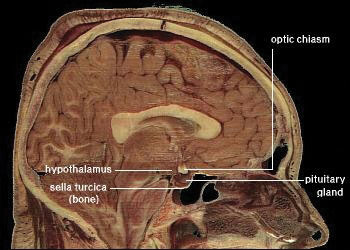
In the last few decades scientific studies have revealed that how much we eat and what we eat is controlled not only by our own desires, but also is regulated physiologically and influenced by genetics. The hypothalamus in the brain is the main control point of appetite. It receives hormonal and neural signals, which determine if you feel hungry or full. Hunger is an unpleasant sensation of feeling empty that is communicated to the brain by both mechanical and chemical signals from the periphery. Conversely,
satiety
is the sensation of feeling full and it also is determined by mechanical and chemical signals relayed from the periphery. The hypothalamus contains distinct centers of neural circuits that regulate hunger and
satiety
(Figure 11.3.2).
Figure 11.3.2: This is a scan of a brain. The hypothalamus contains distinct centers of neural circuits that regulate hunger and
satiety
. Source: Diabesity, Sixth Framework Programme. “Novel Molecular Targets for
Obesity
and
Type 2 Diabetes
.” 2002-2006. www.diabesity.eu/.honours.htm.
Hunger pangs are real and so is a “growling” stomach. When the stomach is empty it contracts, producing the characteristic pang and “growl.” The stomach’s mechanical movements relay neural signals to the hypothalamus, which relays other neural signals to parts of the brain. This results in the conscious feeling of the need to eat. Alternatively, after you eat a meal the stomach stretches and sends a neural signal to the brain stimulating the sensation of
satiety
and relaying the message to stop eating. The stomach also sends out certain
hormones
when it is full and others when it is empty. These
hormones
communicate to the hypothalamus and other areas of the brain either to stop eating or to find some food.
Fat tissue also plays a role in regulating food intake. Fat tissue produces the hormone leptin, which communicates to the
satiety
center in the hypothalamus that the body is in positive
energy balance
. The discovery of leptin’s functions sparked a craze in the research world and in the diet pill industry as it was hypothesized that if you give leptin to a person who is overweight, they will decrease their food intake. Alas, this is not the case. In several clinical trials it was found that people who are overweight or
obese
are actually resistant to the hormone, meaning their brain does not respond as well to it.Dardeno, T. A. et al. “Leptin in Human Physiology and Therapeutics.” Front Neuroendocrinol 31, no. 3 (2010): 377–93. http://www.ncbi.nlm.nih.gov/pmc/articles/PMC2916735/?tool=pubmed. Therefore, when you administer leptin to an overweight or
obese
person there is no sustained effect on food intake.
Nutrients
themselves also play a role in influencing food intake. The hypothalamus senses nutrient levels in the blood. When they are low the hunger center is stimulated, and when they are high the
satiety
center is stimulated. Furthermore, cravings for salty and sweet foods have an underlying physiological basis. Both undernutrition and overnutrition affect hormone levels and the neural circuitry controlling appetite, which makes losing or gaining weight a substantial physiological hurdle.
Genetic Influences
Genetics certainly play a role in body fatness and weight and also affects food intake. Children who have been adopted typically are similar in weight and body fatness to their biological parents. Moreover, identical twins are twice as likely to be of similar weights as compared to fraternal twins. The scientific search for
obesity
genes is ongoing and a few have been identified, such as the gene that encodes for leptin. However, overweight and
obesity
that manifests in millions of people is not likely to be attributed to one or even a few genes, but to rather the interactions of hundreds of genes with the environment. In fact, when an individual has a mutated version of the gene coding for leptin, they are
obese
, but only a few dozen people around the world have been identified as having a completely defective leptin gene.
Psychological/Behavioral Influences
When your mouth waters in response to the smell of a roasting Thanksgiving turkey and steaming hot pies, you are experiencing a psychological influence on food intake. A person’s perception of good-smelling and good-tasting food influences what they eat and how much they eat. Mood and emotions are associated with food intake. Depression, low self-esteem, compulsive disorders, and emotional trauma are sometimes linked with increased food intake and
obesity
.
Certain behaviors can be predictive of how much a person eats. Some of these are how much food a person heaps onto their plate, how often they snack on
calorie
-dense, salty foods, how often they watch television or sit at a computer, and how often they eat out. A study published in a 2008 issue of
Obesity
looked at characteristics of Chinese buffet patrons. The study found that those who chose to immediately eat before browsing the buffet, used larger plates, used a fork rather than chopsticks, and chewed less per bite of food, had higher BMIs than patrons who did not exhibit these behaviors.Levin, B. E. “Developmental Gene X Environment Interactions Affecting Systems Regulating
It is without a doubt that the American society affects what and how much we eat. Portion sizes have increased dramatically in the past few decades. For example, a bagel is now more than twice the size it was in the 1960s. Today, American teenagers have access to a massive amount of
calorie
-dense foods and beverages, which is a large contributor to the recent rapid increase in overweight and
obesity
in adolescents in this country. Even different cultures within the United States have different eating habits. For instance, southern Americans, in general, consume more foods high in fat, which is a contributing factor to their higher incidences of overweight and
obesity
than Americans who live in the northern states. (Alaska is an exception because it also has a high incidence of overweight and
obesity
, which is also partly attributed to diet.)
The fast food industry in America not only supplies Americans with a large proportion of their diet, but because of its massive presence in society dominates the workings of the entire food system. To generalize, most fast food items have little nutritional merit as they are highly processed and rich in saturated fat, salt, and
added sugars
. Despite fast foods being a poor source of nourishment, Americans spend over one hundred billion dollars per year on fast food, up from six billion dollars in the early 1970s. The fast food business is likely to continue to grow in North America (and the rest of the world) and greatly affect the diets of whole populations. Because it is unrealistic to say that Americans should abruptly quit eating fast food to save their health (because they will not) society needs to come up with ideas that push nutrient-dense whole foods into the fast food industry. You may have observed that this largely consumer-driven push is having some effect on the foods the fast food industry serves (just watch a recent Subway commercial, or check the options now available in a McDonald’s Happy Meal). Pushing the fast food industry to serve healthier foods is a realistic and positive way to improve the American diet.
Video 11.3.1: History, Structure, and Ethics of the Fast Food Industry (click to see video) A brief clip about the fast food industry and its effect on the United States.
Tools for Change
Support the consumer movement of pushing the fast food industry and your favorite local restaurants into serving more
nutrient-dense foods
. You can begin this task by starting simple, such as requesting extra tomatoes and lettuce on your burger and more nutrient-dense choices in the salad bar. Also, choose their low-
calorie
menu options and help support the emerging market of healthier choices in the fast food industry. In today’s fast-paced society, it is difficult for most people to avoid fast food all the time. When you do need a quick bite on the run, choose the fast food restaurants that serve healthier foods. Also, start asking for caloric contents of foods so that the restaurant becomes more aware that their patrons are being
calorie
conscious.
Factors Affecting
Energy
Expenditure
Physiological and Genetic Influences
Why is it so difficult for some people to lose weight and for others to gain weight? One theory is that every person has a “set point” of
energy balance
. This set point can also be called a fat-stat or lipostat, meaning the brain senses body fatness and triggers changes in
energy
intake or expenditure to maintain body fatness within a target range. Some believe that this theory provides an explanation as to why after dieting, most people return to their original weight not long after stopping the diet. Another theory is referred to as the “settling” point system, which takes into account (more so than the “set-point” theory) the contribution of the obesogenic environment to weight gain. In this model, the reservoir of body fatness responds to
energy
intake or
energy
expenditure, such that if a person is exposed to a greater amount of food, body fatness increases, or if a person watches more television body fatness increases. A major problem with these theories is that they overgeneralize and do not take into account that not all individuals respond in the same way to changes in food intake or
energy
expenditure. This brings up the importance of the interactions of genes and the environment.
Not all individuals who take a weight-loss drug lose weight and not all people who smoke are thin. An explanation for these discrepancies is that each individual’s genes respond differently to a specific environment. Alternatively, environmental factors can influence a person’s gene profile, which is exemplified by the effects of the prenatal environment on body weight and fatness and
disease
incidence later in life. One of the first scientific investigations of prenatal control over
energy balance
was conducted in Germany. In this observational study, scientists found that offspring born to mothers who experienced famine were more likely to be
obese
in adulthood than offspring born to mothers who were pregnant just after World War II who lived in the same geographical locations.Matthews, C. E. “Amount of Time Spent in Sedentary Behaviors in the United States, 2003–2004.” Am J Epidemiol 167, no. 7 (2008): 875–81. doi: 10.1093/aje/kwm390. Other studies have shown that the offspring of women who were overweight during pregnancy have a greater propensity for being overweight and for developing
Type 2 diabetes
. Thus, undernutrition and overnutrition during pregnancy influence body weight and
disease
risk for offspring later in life. They do so by adapting
energy metabolism
to the early nutrient and hormonal environment in the womb.
Audio Link 11.1: Rethinking Thin - The Myths and Realities of Dieting
Listen to this NPR broadcast for scientific information about why it is so difficult for some people to lose weight.
Psychological/Behavioral Influence
Sedentary behavior
is defined as the participation in the pursuits in which
energy
expenditure is no more than one-and-one-half times the amount of
energy
expended while at rest and include sitting, reclining, or lying down while awake. Of course, the sedentary
lifestyle
of many North Americans contributes to their average
energy
expenditure in daily life. Simply put, the more you sit, the less
energy
you expend. A study published in a 2008 issue of the American Journal of Epidemiology reports that 55 percent of Americans spend 7.7 hours in
sedentary behavior
daily.Matthews, C. E. “Amount of Time Spent in Sedentary Behaviors in the United States, 2003–2004.” Am J Epidemiol 167, no. 7 (2008): 875–81. doi: 10.1093/aje/kwm390. Fortunately, including only a small amount of low-level physical activity benefits weight control. A study published in the June 2001 issue of the International Journal of Behavioral Nutrition and Physical Activity reports that even breaking up sitting-time with frequent, but brief increased
energy
expenditure activities, such as walking for five minutes every hour, helps maintain weight and even aids in weight loss.Wu, Y. “Overweight and
Obesity
in China.” Br Med J 333, no. 7564 (2006): 362. doi: 10.1136/bmj.333.7564.362. Americans partake in an excessive amount of screen time, which is a
sedentary behavior
that not only reduces
energy
expenditure, but also contributes to weight gain because of the exposure to aggressive advertising campaigns for unhealthy foods.
Societal Influence
In the United States, many societal factors influence the number of calories burned in a day. Escalators, moving walkways, and elevators (not to mention cars!) are common modes of transportation that reduce average daily
energy
expenditure. Office work, high-stress jobs, and occupations requiring extended working hours are all societal pressures that reduce the time allotted for exercise of large populations of Americans. Even the remote controls that many have for various electronic devices in their homes contribute to the US society being less active. More “obesogenic” factors were discussed in the opening of this chapter.
Socioeconomic status
has been found to be inversely proportional to weight gain. One reason for this relationship is that inhabitants of low-income neighborhoods have reduced access to safe streets and parks for walking. Another is that fitness clubs are expensive and few are found in lower-income neighborhoods. The recent and long-lasting economic crisis in this country is predicted to have profound effects on the average body weight of Americans. The number of homeless in this country is rising with many children and adults living in hotels and cars. As you can imagine neither of these “home spaces” has a kitchen, making it impossible to cook nutritious meals and resulting in increased economically-forced access to cheap, unhealthy foods, such as that at a nearby gas station.
Key Takeaways
Energy balance
is achieved when
energy
intake is equal to
energy
expended.
Energy balance
is essential for maintaining weight. Knowing the number of calories you need each day is a useful reference point, but it is also important to obtain your calories from
nutrient-dense foods
and consume the
macronutrients
in their AMDRs. The amount of
energy
you expend every day includes not only the calories you burn during physical activity, but also the calories you burn at rest (
basal metabolism
), and the calories you burn when you digest food. Basal metabolic rate (BMR) is dependent on body size, body composition, sex, age, nutritional status, genetics, body temperature, and thyroid hormone levels. The great majority of
energy
expended (between 50 and 70 percent) daily comes from conducting life’s basic processes. The main control a person has over TEE is to increase physical activity.
Energy
intake is regulated by complex physiological responses and is influenced by genetics, behavior, and society.
Energy
expenditure is also regulated by complex physiological responses and is influenced by genetics, behavior, and society.
Discussion Starters
Some types of transportation are becoming economically unfeasible for
obese
people. Discuss whether or not it is acceptable that air carriers can enforce that
obese
people (or what they politely call “passengers of size” or “passengers requiring extra space”) pay more for their seats.
Many people have a hard time understanding the difficulties of being too skinny. Discuss with your peers how to empathize with the weight problems of underweight people. Read the article to understand that being skinny does not mean a person necessarily has a lower risk of chronic


No comments:
Post a Comment