Wednesday, March 26, 2025

Dietary Analysis Assignment


Objective:

  • Evaluate your nutritional intake to see if you are getting all of your nutrients, where you are doing well with regards to nutrition and where improvements can be made.

Part 1: Track your diet and enter your data (30 pts)

You will need to keep a 5 day diet diary of everything (food and beverages) that you consume.  To make this meaningful, you need to be very specific.  

Collecting your data:

Tips
  • Include all food and drink, and be as specific as possible. For example, if you ate chicken, did you eat a leg, thigh or breast?
  • Estimate as carefully as possible the portion size that you ate; for example, ½ cup rice, 10 potato chips, 2 oz tofu etc…
  • Record the cooking or preparation method. For example, was the potato peeled? Was your chicken skinless?  Was it baked or fried?
  • Include anything added to your food such as ketchup, mustard, salad dressing etc.
  • Be sure to record all snacks, beverages and desserts.
  • If the food is from a fast food chain, it is likely already in the database, search by the food item "hamburger" or "cheesecake"
  • You may have to break down mixed dishes into their constituent ingredients.   For example, a tuna sandwich can be listed as 2 slices of whole wheat bread, 1 T of mayo and 3 oz of tuna packed in water
  • NutriCalc has a recipe builder as part of the program so you can enter the recipe and then indicate the serving size you ate.

Part 2: Diet Analysis (70 pts)

In NutriCalc, you will use the All Daily Report to complete your analysis. You will submit a PDF of your complete report (which will include the 5 day diary and the analysis) and answer the questions below.

  • You should answer the questions in a google/word document and upload your document.  We will not use every aspect of the All Daily Report, but it is easier to get everything in one report rather than running the individual reports.  You may find the other reports interesting so you should take a look at those, but for this assignment, you will specifically look at the following aspects of the All Daily Reports:
    • Bar Graph Report
    • Macronutrient Distribution
    • Calorie Assessment

Questions to Answer:

 Calories (10 pts)
  1. Based upon the information you entered, what is your recommended Calorie intake.
  2. On average, was your Calorie intake equal to, above or below your recommended intake?
  3. What changes, if any, would you make to try and stay at your recommended Calorie intake? Note: for some of you this may mean an increase in physical activity and/or decrease in Calorie intake and for some it may be an increase in Calorie intake.
 Carbohydrates (15 pts)
  1. What is the average percent of energy (% Cal) and g of carbohydrates in your diet?  How does this compare with your suggested RDA of energy from carbohydrate?
  2. How does your added sugar (g) compare to the recommended amount?
  3. If your diet does not meet the recommendations, suggests changes that will increase or decrease your carbohydrate intake without changing your energy intakes.  If you DO meet the recommendation, state that "I met the recommendations"
  4. List some foods in your diet that are high in simple carbohydrates and some that are high in complex carbohydrates
  5. How many grams of fiber does your diet provide?  Are you meeting your recommendation for fiber?  If your diet does not meet the recommendations, what modifications can you make to meet them?
 Fats (15 pts)
  1. What is the average daily fat intake in grams and % Calories in your diet?
  2. What is your average daily intake of grams of saturated fat?
  3. How does your fat intake compare with the recommendation of 20-35% of your daily energy from total fat?
  4. If you diet contains more than 35% of energy from fat, suggest changes that will decrease your fat intake without changing your energy intake. If your diet already contains less than 35% of energy form fat, list foods that you typically consume that are high in fat and some lower-fat substitutes that you could try.
  5. Suggest food substitutions that will decrease the amount of saturated fat in your diet.
  6. How much cholesterol does your diet contain (on average)?
 Proteins (15 pts)
  1. What is the average daily protein intake in grams and % Calories in your diet.
  2. How does this compare with your recommended protein intake?  If you consumed more than the RDA, do you think you should decrease your protein intake? Why or why not?   If you consumer less than the RDA for protein, suggest changes that will increase your protein intake to meet needs. How did these changes affect the amount of fat in your diet?
  3. Now compare your protein and fat in your food diary. What is the relationship between them? What foods contribute the most protein to your diet?  Are they animal or plant based?  What percentage of total fat do they provide?
 Vitamins and Minerals (15 pts)

Use the Bar Graph report to answer the following questions. DO NOT COUNT supplements in this analysis

  1. Are there any fat soluble vitamins (ADEK) that you are not getting enough of, or are getting too much of? For any deficiencies in the fat soluble vitamins, list two foods (for each one as appropriate) that you are willing to eat that could increase those vitamins in your diet.
  2. Are there any water soluble vitamins (C and all the B vitamins) that you are not getting enough of, or are getting too much of? For any deficiencies in the water soluble vitamins, list two foods (for each one as appropriate) that you are willing to eat that could increase those vitamins in your diet.
  3. Are there minerals that you are not getting enough of, or are getting too much of? For any deficiencies in the minerals, list two foods (for each one as appropriate) that you are willing to eat that could increase those vitamins in your diet.

Sunday, March 23, 2025

Week 11 discussion board chapter 14

 After reading the chapter 14 three things I would like to educate my friend and family about the nutrition for school age children. As kids grow up from toddlers to school age, their bodies change a lot, and so do their nutritional needs. Between the ages of four and eight, kids need more calories, especially if they're active. Girls usually need between 1,200 to 1,800 calories per day, while boys might need from 1,200 to 2,000 calories. It's important for their diet to have a good mix of carbohydrates, proteins, and fats to support their energy levels and help their bodies grow properly.

Carbs should be about 45–65% of their daily calories because they give kids energy and help their brains work well. Proteins are also key for building muscles and should make up about 10–30% of what they eat. Fats are necessary too but should only be 25–35% of their daily intake to keep them healthy and avoid obesity.

Kids this age also need important vitamins and minerals like iron, fluoride, calcium, and vitamin D. Iron is crucial for their brains, fluoride strengthens their teeth, and calcium and vitamin D are important for strong bones. If kids don't get enough of these from their food, parents should seek the doctor's attention to recommend supplements.

Finally, the eating habits of school-aged children can be influenced a lot by their friends and what's available at school. It's important for parents and caregivers to help guide their food choices by setting a good example and involving them in picking and preparing meals. This helps kids understand why eating well is important and encourages them to try different foods.

Friday, March 21, 2025

16.4: Fuel Sources


16.4: Fuel Sources

The human body uses carbohydrate, fat and protein in food and from body stores as energy. These essential nutrients are needed regardless of the intensity of activity you are doing. If you are lying down reading a book or running the the Honolulu Marathon, these macronutrients are always needed in the body. However, in order for these nutrients to be used as fuel for the body, their energy must be transferred into the high energy molecule known as Adenosine Triphosphate (ATP). ATP is the body’s immediate fuel source of energy that can be generated either with the presences of oxygen known as aerobic metabolism or without the presence of oxygen by anaerobic metabolism. The type of metabolism that is predominately used during physical activity is determined by the availability of oxygen and how much carbohydrate, fat, and protein are used.

Anaerobic and Aerobic Metabolism

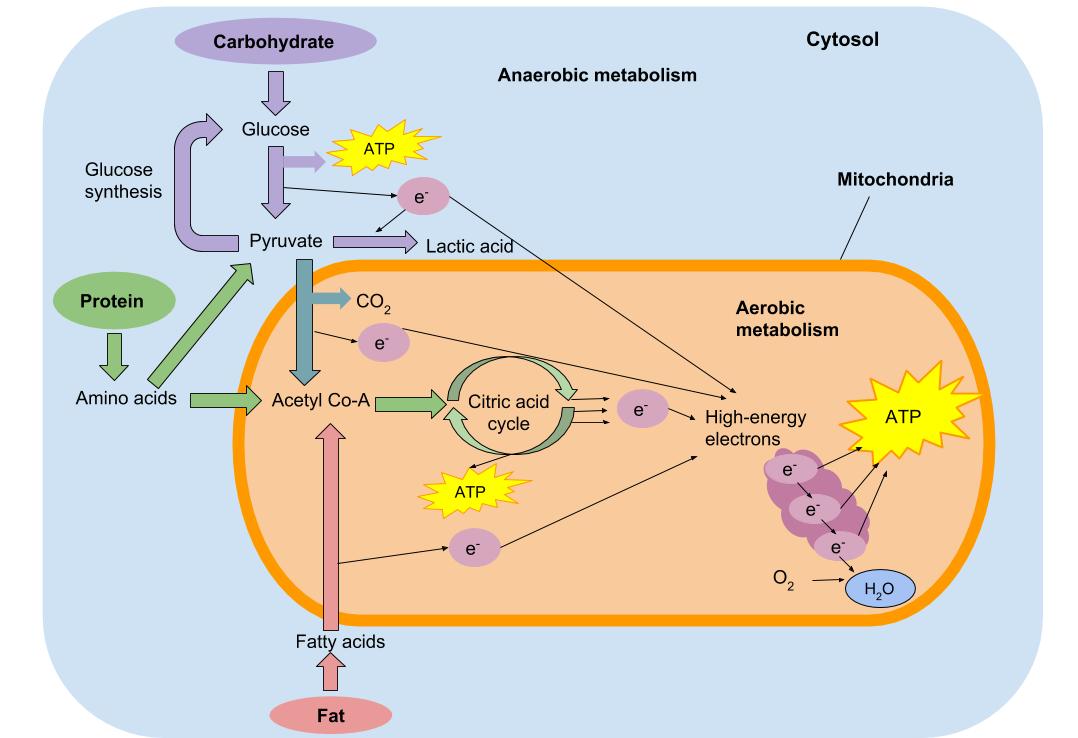
Anaerobic metabolism occurs in the cytosol of the muscle cells. As seen in Figure 16.2, a small amount of ATP is produced in the cytosol without the presence of oxygen. Anaerobic metabolism uses glucose as its only source of fuel and produces pyruvate and lactic acid. Pyruvate can then be used as fuel for aerobic metabolism. Aerobic metabolism takes place in the mitochondria of the cell and is able to use carbohydrates, protein or fat as its fuel source. Aerobic metabolism is a much slower process than anaerobic metabolism but produces majority of the ATP.

Anaerobic versus Aerobic Metabolism
Figure Figure 16.4.1: Anaerobic versus Aerobic Metabolism. Image by Allison Calabrese / CC BY 4.0

Physical Activity Duration and Fuel Use

The respiratory system plays a vital role in the uptake and delivery of oxygen to muscle cells throughout the body. Oxygen is inhaled by the lungs and transferred from the lungs to the blood where the cardiovascular system circulates the oxygen-rich blood to the muscles. The oxygen is then taken up by the muscles and can be used to generate ATP. When the body is at rest, the heart and lungs are able to supply the muscles with adequate amounts of oxygen to meet the aerobic metabolism energy needs. However, during physical activity your muscles energy and oxygen needs are increased. In order to provide more oxygen to the muscle cells, your heart rate and breathing rate will increase. The amount of oxygen that is delivered to the tissues via the cardiovascular and respiratory systems during exercise depend on the duration, intensity and physical conditioning of the individual.

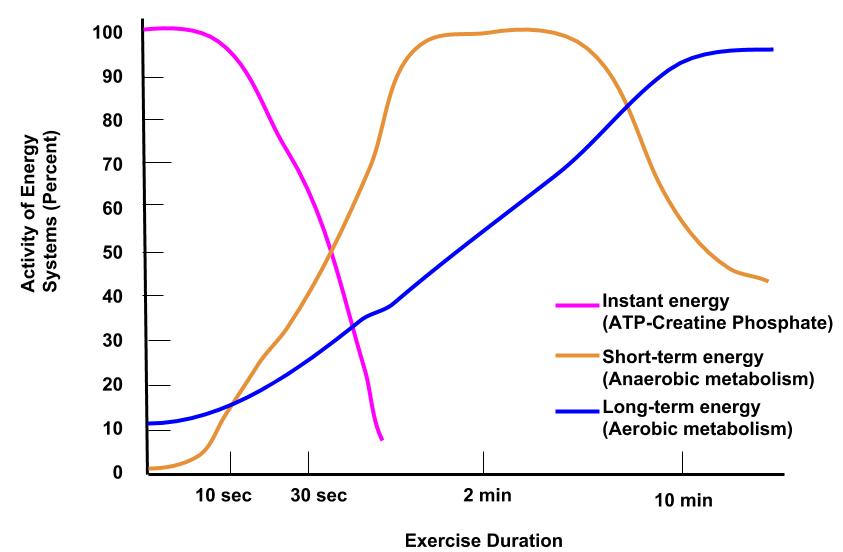
During the first few steps of exercise, your muscles are the first to respond to the change in activity level. Your lungs and heart however do not react as quickly and during those beginning steps they do not begin to increase the delivery of oxygen. In order for our bodies to get the energy that is needed in these beginning steps, the muscles rely on a small amount of ATP that is stored in resting muscles. The stored ATP is able to provide energy for only a few seconds before it is depleted. Once the stored ATP is just about used up, the body resorts to another high-energy molecule known as creatine phosphate to convert ADP (adenosine diphosphate) to ATP. After about 10 seconds, the stored creatine phosphate in the muscle cells are also depleted as well.

About 15 seconds into exercise, the stored ATP and creatine phosphate are used up in the muscles. The heart and lungs have still not adapted to the increase need of oxygen so the muscles must begin to produce ATP by anaerobic metabolism (without oxygen). Anaerobic metabolism can produce ATP at a rapid pace but only uses glucose as its fuel source. The glucose is obtained from the blood of muscle glycogen. At around 30 seconds, anaerobic pathways are operating at their full capacity but because the availability of glucose is limited, it cannot continue for a long period of time.

As your exercise reaches two to three minutes, your heart rate and breathing rate have increased to supply more oxygen to your muscles. Aerobic metabolism is the most efficient way of producing ATP by producing 18 times more ATP for each molecule of glucose than anaerobic metabolism. Although the primary source of ATP in aerobic metabolism is carbohydrates, fatty acids and protein can also be used as fuel to generate ATP.

Exercise-intensity-and-Fuel-4.jpg
Figure 16.4.2: The Effect of Exercise Duration on Energy Systems. Image by Allison Calabrese / CC BY 4.0

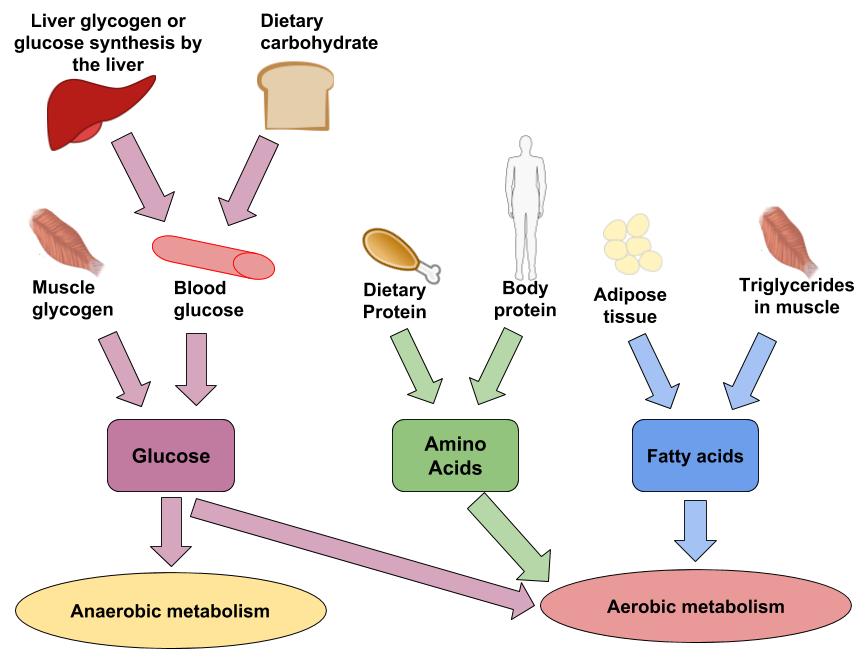
The fuel sources for anaerobic and aerobic metabolism will change depending on the amount of nutrients available and the type of metabolism. Glucose may come from blood glucose (which is from dietary carbohydrates or liver glycogen and glucose synthesis) or muscle glycogen. Glucose is the primary energy source for both anaerobic and aerobic metabolism. Fatty acids are stored as triglycerides in muscles but about 90% of stored energy is found in adipose tissue. As low to moderate intensity exercise continues using aerobic metabolism, fatty acids become the predominant fuel source for the exercising muscles. Although protein is not considered a major energy source, small amounts of amino acids are used while resting or doing an activity. The amount of amino acids used for energy metabolism increase if the total energy intake from your diet does not meet the nutrient needs or if you are involved in long endurance exercises. When amino acids are broken down removing the nitrogen-containing amino acid, that remaining carbon molecule can be broken down into ATP via aerobic metabolism or used to make glucose. When exercise continues for many hours, amino acid use will increase as an energy source and for glucose synthesis.

Fuel Sources for Anaerobic and Aerobic Metabolism
Figure 16.4.3: Fuel Sources for Anaerobic and Aerobic Metabolism. Image by Allison Calabrese / CC BY 4.0

Physical Activity Intensity and Fuel Use

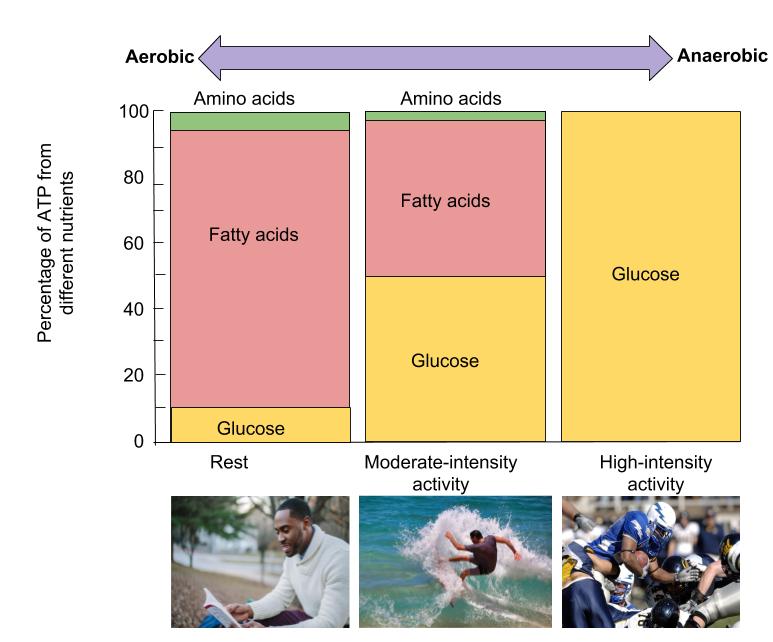
The exercise intensity determines the contribution of the type of fuel source used for ATP production(see Figure 16.4). Both anaerobic and aerobic metabolism combine during exercise to ensure that the muscles are equipped with enough ATP to carry out the demands placed on them. The amount of contribution from each type of metabolism will depend on the intensity of an activity. When low-intensity activities are performed, aerobic metabolism is used to supply enough ATP to muscles. However, during high-intensity activities more ATP is needed so the muscles must rely on both anaerobic and aerobic metabolism to meet the body’s demands.

During low-intensity activities, the body will use aerobic metabolism over anaerobic metabolism because it is more efficient by producing larger amounts of ATP. Fatty acids are the primary energy source during low-intensity activity. With fat reserves in the body being almost unlimited, low-intensity activities are able to continue for a long time. Along with fatty acids, a small amount of glucose is used as well. Glucose differs from fatty acids where glycogen storages can be depleted. As glycogen stores are depleted, fatigue will eventually set in.

Fuel-used-during-exercise.jpg
Figure Figure 16.4.4: The Effect of Exercise Intensity on Fuel Sources. Image by Allison Calabrese / CC BY 4.0
The Fat-Burning Zone

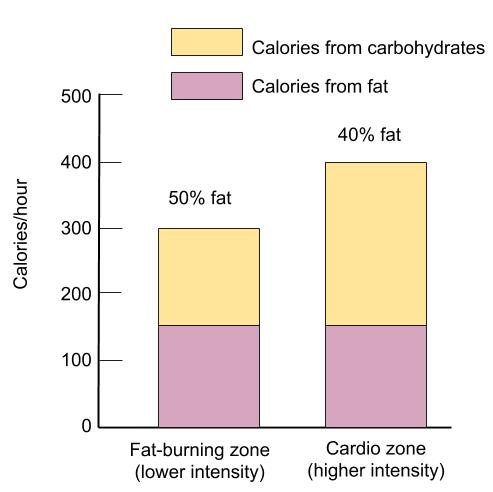
The fat-burning zone is a low intensity aerobic activity that keeps your heart rate between 60 and 69% of your maximum heart rate. The cardio zone on the other hand is a high intensity aerobic activity that keeps the heart rate between about 70 to 85% of your maximum heart rate. So which zone do you burn the most fat in? Technically, your body burns a higher percentage of of calories from fat during a low intensity aerobic activity but there’s more to it than just that. When you begin a low intensity activity, about 50% of the calories burned comes from fat whereas in the cardio zone only 40% come from fat. However, when looking at the actual numbers of calories burned, higher intensity activity burns just as much fat and a much greater total calories overall.

Fat-Burning-Zone.jpg
Figure 16.4.1: Image by Allison Calabrese / CC BY 4.0

“Hitting the Wall” or “Bonking”

If you are familiar with endurance sports, you may have heard of “hitting the wall” or “bonking.” These colloquial terms refer to the extreme fatigue that sets in after about 120 minutes of performing an endurance sport, such as marathon running or long-distance cycling. The physiology underlying “hitting the wall” means that muscles have used up all their stored glycogen and are therefore dependent on other nutrients to support their energy needs. Fatty acids are transported from fat-storing cells to the muscle to rectify the nutrient deficit. However, fatty acids take more time to convert to energy than glucose, thus decreasing performance levels. To avoid “hitting the wall” or “bonking,” endurance athletes load up on carbohydrates for a few days before the event, known as carbohydrate loading. This will maximize an athlete’s amount of glycogen stored in their liver and muscle tissues. It is important not to assume that carbohydrate loading works for everyone. Without accompanied endurance training you will not increase the amount of stored glucose. If you plan on running a five-mile race for fun with your friend and decide to eat a large amount of carbohydrates in the form of a big spaghetti dinner the night before, the excess carbohydrates will be stored as fat. Therefore, if you are not an endurance athlete exercising for more than 90 minutes, carbohydrate loading will provide no benefit, and can even have some disadvantages. Another way for athletes to avoid “hitting the wall” is to consume carbohydrate-containing drinks and foods during an endurance event. In fact, throughout the Tour de France—a twenty-two-day, twenty-four-hundred-mile race—the average cyclist consumes greater than 60 grams of carbohydrates per hour.

Learning Activities

Query 16.4.1

16.3: The Benefits of Physical Activity


16.3: The Benefits of Physical Activity

Regular physical activity is one of the best things you can do to achieve optimal health. Individuals who are physically active for about seven hours per week lower the risk of dying early by 40 percent compared to those who are active for less than thirty minutes per week.[1] Improving your overall fitness involves sticking with an exercise program on a regular basis. If you are nervous or unsure about becoming more active, the good news is that moderate-intensity activity, such as brisk walking, is safe for most people. Also, the health advantages of becoming active far outweigh the risks. Physical activity not only helps to maintain your weight, it also provides a wealth of benefits—physical, mental, and emotional.

Physical Benefits

Getting the recommended amount of physical activity each week, about 150 minutes of moderate, aerobic exercise, such as power walking or bicycling, does not require joining a gym, or taking expensive, complicated classes. If you can’t commit to a formal workout four to five days per week, you can become more active in simple ways—by taking the stairs instead of the elevator, by walking more instead of driving, by going out dancing with your friends, or by doing your household chores at a faster pace. It is not necessary to perform at the level of a professional dancer or athlete, or to work out for several hours every day, to see real gains from exercise. Even slightly increased activity can lead to physical benefits, such as:

  • Longer life. A regular exercise program can reduce your risk of dying early from heart disease, certain cancers, and other leading causes of death.
  • Healthier weight. Exercise, along with a healthy, balanced eating plan, can help you lose extra weight, maintain weight loss, or prevent excessive weight gain.
  • Cardiovascular disease prevention. Being active boosts HDL cholesterol and decreases unhealthy triglycerides, which reduces the risk of cardiovascular diseases.
  • Management of chronic conditions. A regular routine can help to prevent or manage a wide range of conditions and concerns, such as metabolic syndrome, type 2 diabetes, depression, arthritis, and certain types of cancer.
  • Energy boosts. Regular physical activity can improve muscle tone and strength and provide a boost to your cardiovascular system. When the heart and lungs work more efficiently, you have more energy.
  • Strong bones. Research shows that aerobic activity and strength training can slow the loss of bone density that typically accompanies aging.

Mental and Emotional Benefits

The benefits of an exercise program are not just physical, they are mental and emotional as well. Anyone who has gone for a walk to clear their head knows the mental benefits of exercise firsthand. Also, you do not have to be a marathoner on a “runner’s high” to enjoy the emotional benefits of becoming active. The mental and emotional benefits of physical activity include:

  • Mood improvement. Aerobic activity, strength-training, and more contemplative activities such as yoga, all help break cycles of worry, absorption, and distraction, effectively draining tension from the body.
  • Reduced risk of depression, or limited symptoms of it. Some people have called exercise “nature’s antidepressant,” and studies have shown that physical activity reduces the risk of and helps people cope with the symptoms of depression.
  • Cognitive skills retention. Regular physical activity can help people maintain thinking, learning, and judgement as they age.
  • Better sleep. A good night’s sleep is essential for clear thinking, and regular exercise promotes healthy, sound sleep. It can also help you fall asleep faster and deepen your rest.

Changing to a More Active Lifestyle

A physically active lifestyle yields so many health benefits that it is recommended for everyone. Change is not always easy, but even small changes such as taking the stairs instead of the elevator, or parking farther away from a store to add a bit more walking into your day can lead to a more active lifestyle and set you on the road to optimal health. When people go one step further by walking or biking on a regular basis, or becoming active by growing and maintaining a garden, they do more than promote their own health—they safeguard the health of the planet, too.

As you change to a more active lifestyle, select an activity that you can integrate into your schedule smoothly, so you can maintain it. For example, instead of making time to get coffee with friends, you might suggest a walk, rollerblading, or going for a swim in the campus pool. Also, find an activity that you will be motivated to do. Some people decide to participate in team sports, such as local soccer or softball leagues, because they enjoy being active with others or like knowing that a team relies on them. Others prefer to take a class, such as spinning or yoga, that is led by an instructor who will motivate them. Still others prefer more solitary pursuits, such as taking a jog alone in their neighborhood. No matter what your preference, you are more likely to stick to a workout program if you enjoy it.

Query 16.3.1