Protein makes up approximately 20 percent of the human body and is present in every single cell. The word protein is a Greek word, meaning “of utmost importance.”
Proteins
are called the workhorses of life as they provide the body with structure and perform a vast array of functions. You can stand, walk, run, skate, swim, and more because of your protein-rich muscles. Protein is necessary for proper immune system
function, digestion, and hair and nail growth, and is involved in numerous other body functions.
In fact, it is estimated that more than one hundred thousand different proteins
exist within the human body.
In this chapter you will learn about the components of protein, the important roles that protein serves within the body, how the body uses protein, the risks and consequences associated with too much or too little protein, and where to find healthy sources of it in your diet.
Your protein-rich muscles allow for body strength and movement, which enable you to enjoy many activities. Australia v Japan on 24 March 2012 at Hawker International Softball Centre. (CC-SA-BY 3.0; LauraHale)
What Is Protein?
Proteins
, simply put, are macromolecules composed of amino acids
. Amino acids
are commonly called protein’s building blocks. Proteins
are crucial for the nourishment, renewal, and continuance of life. Proteins
contain the elements carbon, hydrogen, and oxygen just as carbohydrates
and lipids
do, but proteins
are the only macronutrient that contains nitrogen. In each amino acid the elements are arranged into a specific conformation around a carbon center.
Each amino acid consists of a central carbon atom connected to a side chain, a hydrogen, a nitrogen-containing amino group, a carboxylic acid group—hence the name “amino acid.” Amino acids
differ from each other by which specific side chain is bonded to the carbon center.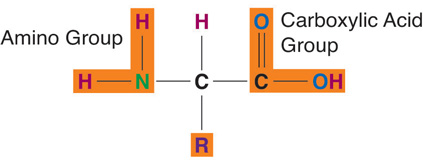
It’s All in the Side Chain
The side chain of an amino acid, sometimes called the “R” group, can be as simple as one hydrogen bonded to the carbon center, or as complex as a six-carbon ring bonded to the carbon center. Although each side chain of the twenty
amino acids
is unique, there are some chemical likenesses among them. Therefore, they can be classified into four different groups (Figure 6.2.2). These are nonpolar, polar, acidic, and basic.Nonpolar amino acids
. Nonpolar amino acids
include alanine (Ala), leucine (Leu), isoleucine (Ile), proline (Pro), tryptophan (Trp), valine (Val), phenylalanine (Phe), and methionine (Met). The side chains of these amino acids
are long carbon chains or carbon rings, making them bulky. They are hydrophobic, meaning they repel water.Polar amino acids
. Polar amino acids
are glycine (Gly), serine (Ser), threonine (Thr), cysteine (Cys), tyrosine (Tyr), asparagine (Asn), and glutamine (Gln). The side chains of polar amino acids
make them hydrophilic, meaning they are water-soluble.Acidic amino acids
. Acidic amino acids
are negatively charged, hydrophilic amino acids
and include aspartic acid (Asp) and glutamic acid (Glu).Basic amino acids
. Basic amino acids
are positively charged, hydrophilic amino acids
and include lysine (Lys), arginine (Arg), and histidine (His).
Essential and Nonessential Amino Acids
Amino acids
are further classified based on nutritional aspects. Recall that there are twenty different amino acids
, and we require all of them to make the many different proteins
found throughout the body (Table 6.2.1). Eleven of these are called nonessential amino acids
because the body can synthesize them. However, nine of the amino acids
are called essential amino acids
because we cannot synthesize them either at all or in sufficient amounts. These must be obtained from the diet. Sometimes during infancy, growth, and in diseased states the body cannot synthesize enough of some of the nonessential amino acids
and more of them are required in the diet. These types of amino acids
are called conditionally essential amino acids
. The nutritional value of a protein is dependent on what amino acids
it contains and in what quantities.Table 6.2.1: Essential and Nonessential Amino Acids
| Essential | Nonessential |
|---|
| Histidine | Alanine |
| Isoleucine | Arginine* |
| Leucine | Asparagine |
| Lysine | Aspartic acid |
| Methionine | Cysteine* |
| Phenylalanine | Glutamic acid |
| Threonine | Glutamine* |
| Tryptophan | Glycine* |
| Valine | Proline* |
| Serine |
| Tyrosine* |
| *Conditionally essential |
|---|
The Many Different Types of Proteins
As discussed, there are over one hundred thousand different
proteins
in the human body. Different proteins
are produced because there are twenty types of naturally occurring amino acids
that are combined in unique sequences. Additionally, proteins
come in many different sizes. The hormone insulin, which regulates blood glucose, is composed of only fifty-one amino acids
; whereas collagen
, a protein that acts like glue between cells, consists of more than one thousand amino acids
. Titin is the largest known protein. It accounts for the elasticity of muscles, and consists of more than twenty-five thousand amino acids
! The abundant variations of proteins
are due to the unending number of amino acid sequences that can be formed. To compare how so many different proteins
can be designed from only twenty amino acids
, think about music. All of the music that exists in the world has been derived from a basic set of seven notes C, D, E, F, G, A, B and variations thereof. As a result, there is a vast array of music and songs all composed of specific sequences from these basic musical notes. Similarly, the twenty amino acids
can be linked together in an extraordinary number of sequences, much more than are possible for the seven musical notes to create songs. As a result, there are enormous variations and potential amino acid sequences that can be created. For example, if an amino acid sequence for a protein is 104 amino acids
long the possible combinations of amino acid sequences is equal to 20104, which is 2 followed by 135 zeros!Building Proteins
with Amino Acids
The building of a protein consists of a complex series of chemical reactions that can be summarized into three basic steps: transcription, translation, and
protein folding
(Figure 6.2.3). The first step in constructing a protein is the transcription (copying) of the genetic information in double-stranded deoxyribonucleic acid (DNA) into the single-stranded, messenger macromolecule ribonucleic acid (RNA). RNA is chemically similar to DNA, but has two differences; one is that its backbone uses the sugar ribose and not deoxyribose; and two, it contains the nucleotide base uracil, and not thymidine. The RNA that is transcribed from a given piece of DNA contains the same information as that DNA, but it is now in a form that can be read by the cellular protein manufacturer known as the ribosome. Next, the RNA instructs the cells to gather all the necessary amino acids
and add them to the growing protein chain in a very specific order. This process is referred to as translation. The decoding of genetic information to synthesize a protein is the central foundation of modern biology.During translation each amino acid is connected to the next amino acid by a special chemical bond called a
peptide bond
(Figure 6.4). The peptide bond
forms between the carboxylic acid group of one amino acid and the amino group of another, releasing a molecule of water. The third step in protein production involves folding it into its correct shape. Specific amino acid sequences contain all the information necessary to spontaneously fold into a particular shape. A change in the amino acid sequence will cause a change in protein shape. Each protein in the human body differs in its amino acid sequence and consequently, its shape. The newly synthesized protein is structured to perform a particular function in a cell. A protein made with an incorrectly placed amino acid may not function properly and this can sometimes cause disease
.Protein Organization
Protein’s structure enables it to perform a
variety
of functions. Proteins
are similar to carbohydrates
and lipids
in that they are polymers of simple repeating units; however, proteins
are much more structurally complex. In contrast to carbohydrates
, which have identical repeating units, proteins
are made up of amino acids
that are different from one another. Furthermore, a protein is organized into four different structural levels (Figure 6.5). The first level is the one-dimensional sequence of amino acids
that are held together by peptide bonds. Carbohydrates
and lipids
also are one-dimensional sequences of their respective monomers, which may be branched, coiled, fibrous, or globular, but their conformation is much more random and is not organized by their sequence of monomers. In contrast, the two-dimensional level of protein structure is dependent on the chemical interactions between amino acids
, which cause the protein to fold into a specific shape, such as a helix (like a coiled spring) or sheet. The third level of protein structure is three-dimensional. As the different side chains of amino acids
chemically interact, they either repel or attract each other, resulting in the coiled structure. Thus, the specific sequence of amino acids
in a protein directs the protein to fold into a specific, organized shape. The fourth level of structure (also known as its “quaternary” structure) is achieved when protein fragments called peptides combine to make one larger functional protein. The protein hemoglobin is an example of a protein that has quaternary structure. It is composed of four peptides that bond together to form a functional oxygen carrier. A protein’s structure also influences its nutritional quality. Large fibrous protein structures are more difficult to digest than smaller proteins
and some, such as keratin
, are indigestible. Because digestion of some fibrous proteins
is incomplete, not all of the amino acids
are absorbed and available for the body to utilize, thereby decreasing their nutritional value.Amino acids
differ chemically in the molecular composition of their side chains, but they do have some similarities. They are grouped into four different types: nonpolar, polar, acidic, and basic.Amino acids
are also categorized based upon their nutritional aspects. Some are nonessential in the diet because the body can synthesize them, and some are essential in the diet because the body cannot make them.Proteins
are polymers of amino acid monomers held together by peptide bonds. They are built in three steps; transcription, translation, and folding.Proteins
have up to four different levels of structure, making them much more complex than carbohydrates
or lipids
.
Discussion Starters
- There are over four thousand diseases caused by incorrectly built protein. Find out more about how one incorrectly placed amino acid causes the
disease
sickle cell anemia by watching this animation.http://www.dnalc.org/resources/3d/17-sickle-cell.html.
- Why do you think protein-building diseases are rare? In every cell in your body over ten million ribosomes are at work constructing millions of
proteins
every minute. What can you say about the body’s amazing track record in correctly building proteins
?
Reflection summary
Proteins are essential macromolecules that make up about 20 percent of the human body and are found in every cell. They are crucial for various functions such as movement, immune system response, digestion, and the growth of hair and nails. There are over 100,000 different proteins in the body, each made up of amino acids, which are the building blocks of proteins. These amino acids contain carbon, hydrogen, oxygen, and nitrogen, and are linked together by peptide bonds to form proteins.
Amino acids are divided into nonpolar, polar, acidic, and basic types, based on the nature of their side chains. This classification affects how amino acids interact with each other and how proteins function within the body. There are twenty different amino acids, nine of which are essential because our bodies cannot synthesize them. They must be obtained from our diet, emphasizing the importance of a nutritionally balanced diet.
The synthesis of proteins is a detailed process involving transcription, translation, and folding. This process starts with the transcription of DNA into RNA, followed by the translation where the RNA guides the synthesis of proteins by arranging amino acids in specific sequences. Finally, these sequences fold into complex three-dimensional structures that determine the function of the protein.
Proteins have a sophisticated structure organized into four levels—primary, secondary, tertiary, and quaternary. Each level of structure plays a critical role in the stability and function of proteins. For instance, the quaternary structure of hemoglobin helps it transport oxygen efficiently through the blood.
Understanding proteins and their functions helps us appreciate how vital they are to life and health. Learning about how amino acids form proteins and the impact of their arrangement gives insights into genetic diseases like sickle cell anemia, where just one misplaced amino acid can cause significant health issues. This knowledge underscores the precision of molecular biology and the complexity of our bodies in synthesizing and managing millions of proteins accurately.


No comments:
Post a Comment