Sunday, February 16, 2025

Protein function in the body


6.5: Protein’s Functions in the Body

  • Anonymous
  • LibreTexts

Learning Objectives

  • List protein’s functions in the body.

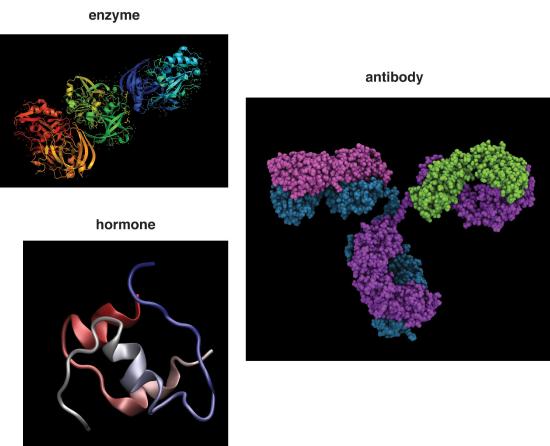
 are the “workhorses” of the body and participate in many bodily functions. As you may recall,  come in all sizes and shapes and each is specifically structured for its particular function.

edb0ac896a88a0cabf7f3c1d5b54777f.jpg

 come in all sizes and shapes.

Structure and Motion

More than one hundred different structural 
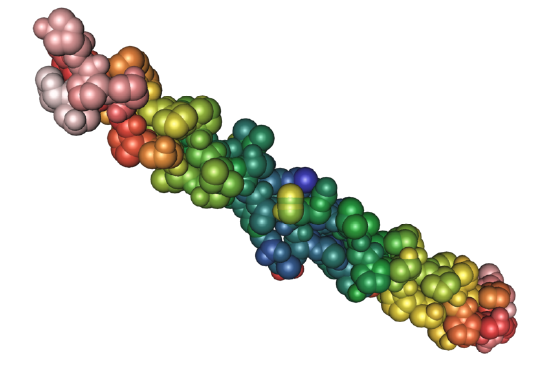
 have been discovered in the human body, but the most abundant by far is , which makes up about 6 percent of total body weight.  makes up 30 percent of bone tissue and comprises large amounts of tendons, ligaments, cartilage, skin, and muscle.  is a strong, fibrous protein made up of mostly glycine and proline . Within its quaternary structure three protein strands twist around each other like a rope and then these  ropes overlap with others. This highly ordered structure is even stronger than steel fibers of the same size.  makes bones strong, but flexible.  fibers in the skin’s dermis provide it with structure, and the accompanying elastin protein fibrils make it flexible. Pinch the skin on your hand and then let go; the  and elastin  in skin allow it to go back to its original shape. Smooth-muscle cells that secrete  and elastin  surround blood vessels, providing the vessels with structure and the ability to stretch back after blood is pumped through them. Another strong, fibrous protein is , which is what skin, hair, and nails are made of.

800px-1bkv_collagen_02.png

: A strong protein made up of three intertwined peptides. Image used wtih permission (CC-SA-By; Nevit Dilmen).

The closely packed 

 fibrils in tendons and ligaments allow for synchronous mechanical movements of bones and muscle and the ability of these  to spring back after a movement is complete. Move your fingers and watch the synchrony of your knuckle movements. In order to move, muscles must contract. The contractile parts of muscles are the  actin and . When these  are stimulated by a nerve impulse they slide across each other, causing a shortening of the muscle cell. Upon stimulation, multiple muscle cells shorten at the same time, resulting in muscle contraction.

Although 

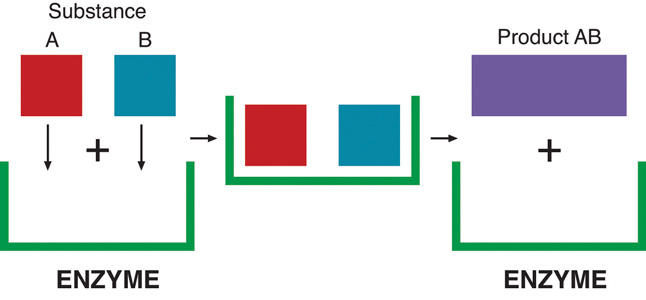
 are found in the greatest amounts in connective  such as bone, their most extraordinary function is as  are  that conduct specific chemical reactions. An enzyme’s job is to provide a site for a chemical reaction and to lower the amount of  and time it takes for that chemical reaction to happen (this is known as “catalysis”). On average, more than one hundred chemical reactions occur in cells every single second and most of them require . The liver alone contains over one thousand enzyme systems.  are specific and will use only particular substrates that fit into their active site, similar to the way a lock can be opened only with a specific key. Nearly every chemical reaction requires a specific enzyme. Fortunately, an enzyme can fulfill its role as a catalyst over and over again, although eventually it is destroyed and rebuilt. All bodily functions, including the breakdown of  in the stomach and small intestine, the transformation of  into molecules a cell can use, and building all macromolecules, including protein itself, involve .

60a2d891f535077c0a7f8419a3b5fa48.jpg

 are . An enzyme’s job is to provide a site for substances to chemically react and form a product, and decrease the amount of  and time it takes for this to happen.

Video 6.5.2: Enzyme

Watch this animation of an enzyme at work. (click to see video)

 are responsible for hormone synthesis. Recall that  are the chemical messages produced by the endocrine glands. When an endocrine gland is stimulated, it releases a hormone. The hormone is then transported in the blood to its target cell, where it communicates a message to initiate a specific reaction or cellular process. For instance, after you eat a meal, your blood glucose levels rise. In response to the increased blood glucose, the pancreas releases the hormone insulin. Insulin tells the cells of the body that glucose is available and to take it up from the blood and store it or use it for making  or building macromolecules. A major function of  is to turn  on and off, so some  can even regulate the actions of other . While not all  are made from , many of them are.

Fluid and Acid-Base Balance

Proper protein intake enables the basic biological processes of the body to maintain the status quo in a changing environment. Fluid balance refers to maintaining the distribution of water in the body. If too much water in the blood suddenly moves into a tissue, the results are swelling and, potentially, cell death. Water always flows from an area of high 
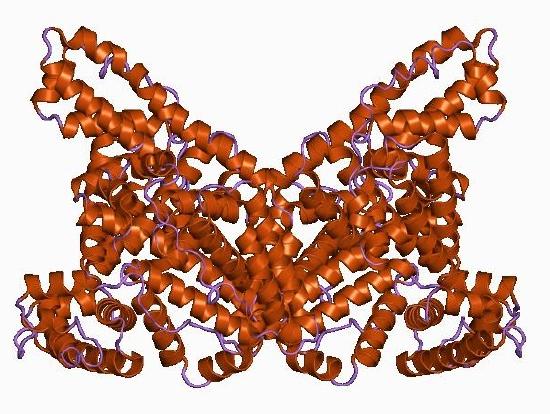
 to one of a low . As a result, water moves toward areas that have higher concentrations of other , such as  and glucose. To keep the water evenly distributed between blood and cells,  continuously circulate at high concentrations in the blood. The most abundant protein in blood is the butterfly-shaped protein known as ’s presence in the blood makes the protein  in the blood similar to that in cells. Therefore, fluid exchange between the blood and cells is not in the extreme, but rather is minimized to preserve the status quo.

PDB_1ao6_EBI.jpg

The butterfly-shaped protein, 

, has many functions in the body including maintaining fluid and acid-base balance and transporting molecules. Cartoon representation of the molecular structure of protein registered with 1ao6 code. (Public Domain; Jawahar Swaminathan and MSD staff at the European Bioinformatics Institute).

Protein is also essential in maintaining proper pH balance (the measure of how acidic or basic a substance is) in the blood. Blood pH is maintained between 7.35 and 7.45, which is slightly basic. Even a slight change in blood pH can affect body functions. Recall that acidic conditions can cause protein 

, which stops  from functioning. The body has several systems that hold the blood pH within the normal range to prevent this from happening. One of these is the circulating  is slightly acidic, and because it is negatively charged it balances the many positively charged molecules, such as hydrogen protons (H+), , potassium, and  which are also circulating in the blood.  acts as a buffer against abrupt changes in the concentrations of these molecules, thereby balancing blood pH and maintaining the status quo. The protein hemoglobin also participates in acid-base balance by binding hydrogen protons.

Transport

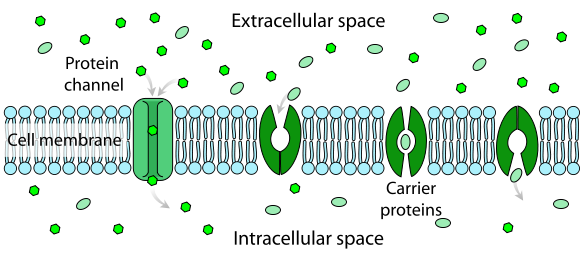
 and hemoglobin also play a role in molecular transport.  chemically binds to , some vitamins, essential minerals, and drugs, and transports them throughout the . Each red blood cell contains millions of hemoglobin molecules that bind oxygen in the lungs and transport it to all the  in the body. A cell’s plasma membrane is usually not permeable to large polar molecules, so to get the required  and molecules into the cell many transport  exist in the cell membrane. Some of these  are channels that allow particular molecules to move in and out of cells. Others act as one-way taxis and require  to function (Figure 6.5.1).

581px-Scheme_facilitated_diffusion_in_cell_membrane-en.svg.png
Figure 6.5.1: Molecules move in and out of cells through transport , which are either channels or carriers. Facilitated diffusion in cell membrane, showing ion channels (left) and carrier  (three on the right). (Public Domain; LadyofHats).

Protection

Earlier we discussed that the strong 
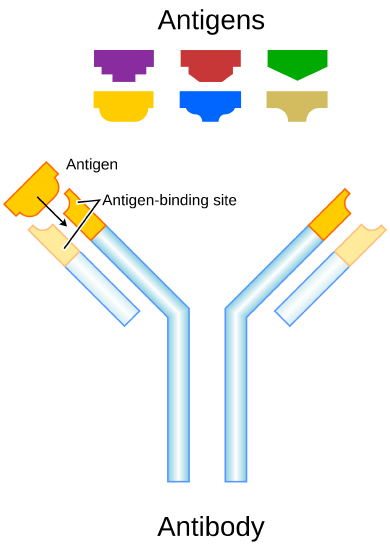
 fibers in skin provide it with structure and support. The skin’s dense network of  fibers also serves as a barricade against harmful substances. The ’s attack and destroy functions are dependent on  and , which are also . An enzyme called lysozyme is secreted in the saliva and attacks the walls of bacteria, causing them to rupture. Certain  circulating in the blood can be directed to build a molecular knife that stabs the cellular membranes of foreign invaders. The  secreted by the white blood cells survey the entire  looking for harmful bacteria and viruses to surround and destroy.  also trigger other factors in the  to seek and destroy unwanted intruders.

151690756111858248.png

 play a role in protecting the body against unwanted intruders.  surround and attack an influenza virus via "antigens" on thier surface. Each antibody binds to a specific antigen; an interaction similar to a lock and key. (Public Domain; Fvasconcellos and USA government).

Wound Healing and Tissue Regeneration

 are involved in all aspects of wound healing, a process that takes place in three phases: inflammatory, proliferative, and remodeling. For example, if you were sewing and pricked your finger with a needle, your flesh would turn red and become inflamed. Within a few seconds bleeding would stop. The healing process begins with  such as bradykinin, which dilate blood vessels at the site of injury. An additional protein called fibrin helps to secure  that form a clot to stop the bleeding. Next, in the proliferative phase, cells move in and mend the injured tissue by installing newly made  fibers. The  fibers help pull the wound edges together. In the remodeling phase, more  is deposited, forming a scar. Scar tissue is only about 80 percent as functional as normal uninjured tissue. If a diet is insufficient in protein, the process of wound healing is markedly slowed.

While wound healing takes place only after an injury is sustained, a different process called tissue regeneration is ongoing in the body. The main difference between wound healing and tissue regeneration is in the process of regenerating an exact structural and functional copy of the lost tissue. Thus, old, dying tissue is not replaced with scar tissue but with brand new, fully functional tissue. Some cells (such as skin, hair, nails, and intestinal cells) have a very high rate of regeneration, while others, (such as heart-muscle cells and nerve cells) do not regenerate at any appreciable levels. Tissue regeneration is the creation of new cells (cell division), which requires many different 

 including  that synthesize RNA and , transport , and . In a hair follicle, cells divide and a hair grows in length. Hair growth averages 1 centimeter per month and fingernails about 1 centimeter every one hundred days. The cells lining the intestine regenerate every three to five days. Protein-inadequate diets impair tissue regeneration, causing many health problems including impairment of nutrient digestion and absorption and, most visibly, hair and nail growth.

 Production

Some of the 

 in  can be disassembled and used to make . Only about 10 percent of dietary  are catabolized each day to make cellular . The liver is able to break down  to the carbon skeleton, which can then be fed into the citric acid cycle. This is similar to the way that glucose is used to make ATP. If a person’s diet does not contain enough  and fats their body will use more  to make , which compromises the synthesis of new  and destroys muscle . Alternatively, if a person’s diet contains more protein than the body needs, the extra  will be broken down and transformed into fat.

Key Takeaways

  • The many shapes and sizes of  allow them to perform a vast array of functions, including: acting as  and , and providing for fluid and acid-base balance, transport, protection, wound healing and tissue regeneration, and  production.
  • Without  intake of protein containing all the essential , all protein functions will be impaired.

Discussion Starter

  1. Given protein’s critical roles in the , what do you think might occur more frequently in a person whose diet is protein deficient?
reflection 
Proteins are crucial for numerous functions within the body, each shaped specifically to perform a distinct role effectively. This reflection will explore the multifaceted roles of proteins and emphasize their importance in health and disease prevention.

Structural and Functional Roles of Proteins

Proteins like collagen and keratin provide structural support to various body parts. Collagen, which makes up a significant portion of bone, skin, and muscle tissue, is incredibly strong and flexible. This protein is essential for maintaining the resilience and elasticity of these tissues, helping them to withstand stress without breaking. Similarly, keratin strengthens hair and nails, providing durability and protection against physical damage.

Enzymatic and Hormonal Functions

Proteins also function as enzymes, facilitating countless chemical reactions in the body that are vital for survival. These reactions occur every second and are crucial for everything from digestion to DNA replication. Enzymes reduce the energy required for reactions, ensuring efficiency and speed in metabolic processes.

Hormones, many of which are proteins, serve as chemical messengers that regulate bodily functions. For example, insulin, a protein hormone, helps manage blood glucose levels by signaling cells to absorb glucose from the bloodstream. This regulatory role is critical for energy balance and overall metabolic health.

Transport and Maintenance of Homeostasis

Proteins like albumin play a key role in transporting substances such as fatty acids, hormones, vitamins, and minerals throughout the body. Albumin also helps maintain fluid balance and pH levels in the blood, preventing sudden shifts that could disrupt cellular function and overall health.

Immune Protection and Tissue Repair

In the immune system, proteins act as antibodies that identify and neutralize foreign invaders such as viruses and bacteria. These proteins are fundamental in defending the body against infections and diseases. Additionally, proteins are involved in wound healing and tissue regeneration, processes that repair damaged tissues and replace old or dying cells with new ones.

No comments:

Post a Comment